

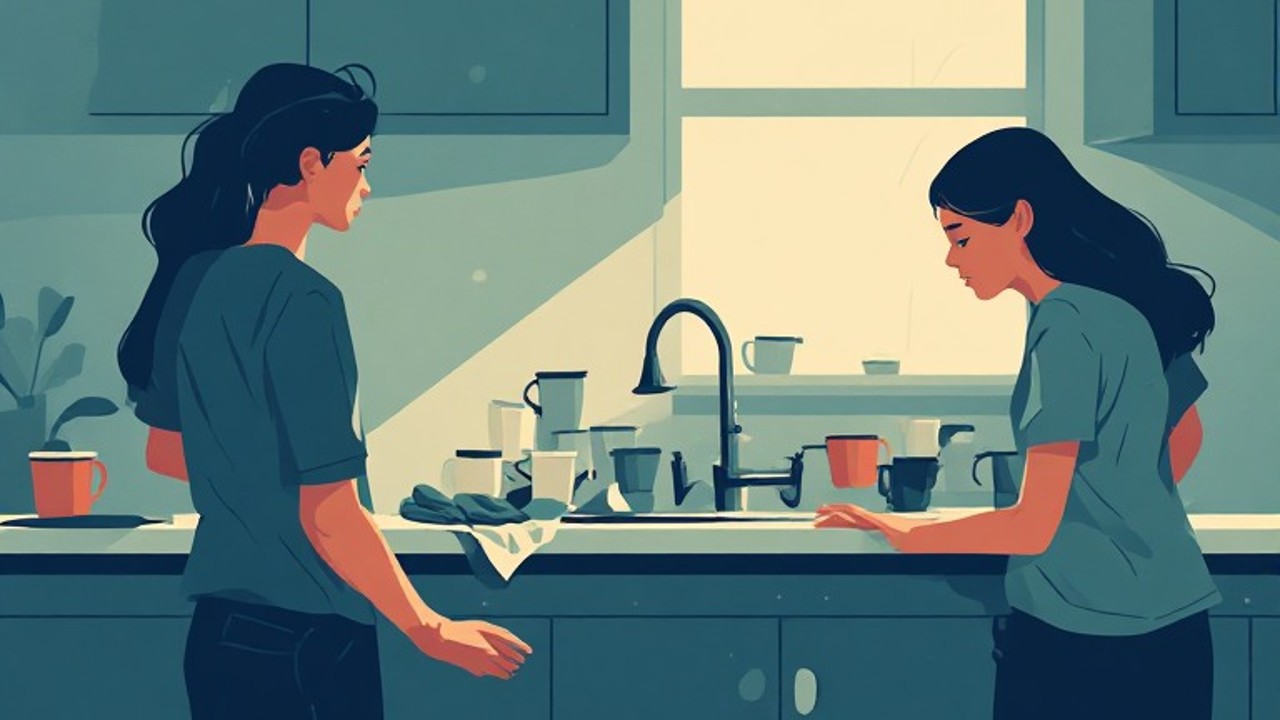
You snap at your partner about the dishes, and suddenly you are arguing about money, your mother, and that thing they said three years ago. The dishes were never the point. A 2024 review of conflict research across fields found that team clashes fall into three buckets — relationship, task, and process — and that the style people reach for first shapes the outcome more than the topic does (Orchard et al., 2024). A separate systematic review of nurse managers identified seven recurring patterns in how leaders handle friction, from avoidance to collaboration (González-García et al., 2025).
The short version
People tend to default to one conflict style — avoiding, accommodating, competing, compromising, or collaborating, and that habit predicts relationship health better than the specific disagreement. The evidence comes from literature reviews, not controlled experiments, so we cannot say the style causes the outcome. Still, noticing your own pattern is a low-risk step toward changing it.
What the reviews actually tell us
The 2024 critical review scanned conflict models from many disciplines and concluded that conflict in teams takes three forms: relationship conflict (personal friction), task conflict (disagreement about the work), and process conflict (disagreement about how the work gets done) (Orchard et al., 2024). The authors argue that training in a "constructive controversy" approach, basically, learning to debate ideas without attacking people, shifts groups toward cooperation. The review does not test this claim with new data; it synthesizes what earlier studies have reported.
The 2025 systematic review of nurse managers coded 71 characteristics from 14 studies and grouped them into seven clusters (González-García et al., 2025). The biggest clusters were collaborative resolution (about 20 percent of coded items) and collaborative support (about 18 percent). Avoidance, accommodation, compromise, and assertive dominance each appeared around 12 to 14 percent. The most common triggers were interpersonal clashes (22 percent), resource allocation (20 percent), and clashes between personal values and organizational goals (18 percent). Again, this is a map of what researchers have observed, not a controlled test of cause and effect.
Think of conflict style like a default keyboard shortcut. You press the same key combination every time a window pops up, even when a different shortcut would work better. The reviews suggest that learning new shortcuts, pausing, naming the type of conflict, choosing a response, can change the result, but the evidence for that claim is mostly indirect.
Why this shows up in ordinary life
When you default to avoidance, the dishes stay in the sink and resentment builds. When you default to accommodation, you do the dishes every night and feel taken for granted. When you default to competing, you win the argument about the dishes but lose the feeling of partnership. The nurse-manager review found that collaborative resolution and collaborative support were the most frequently cited effective behaviors (González-García et al., 2025). That does not mean collaboration is always the right answer; it means it appears most often in the literature as a marker of competence.
The APS collection on conflict resolution notes that people can train themselves to approach social conflicts more wisely by practicing distanced self-talk, stepping back and narrating the situation in the third person (Association for Psychological Science). That is a concrete, low-effort experiment: next time you feel the familiar tug toward your usual style, try saying silently, "Sam is feeling angry about the dishes because Sam values fairness." The evidence base for this specific technique is thin, but the risk is near zero.
What to try this week
-
Pick a typical day and notice the moment tension rises, maybe a sigh, a sharp tone, or the urge to walk away. Jot down what you did next and which of the five styles it matches.
-
When the next disagreement appears, pause and ask yourself whether the clash is about the task, the process, or the relationship (Orchard et al., 2024). Naming the type helps you choose a response instead of defaulting.
-
For seven days, try one small swap: if you usually avoid, speak up once; if you usually compete, ask a question instead. Keep the stakes low, deciding on dinner, not the mortgage.
-
After each swap, write one line about how the other person reacted and how you felt afterward. Patterns show up faster on paper than in memory.
-
At the end of the week, review your notes and circle the style that appeared most often. That circle is your starting map. this won't help if the conflict involves safety concerns or a power imbalance that requires professional support
Where people go wrong
Believing your style is fixed
The nurse-manager review describes patterns people display, not traits they are. Styles shift with context, stress, and who is across the table. Treating a habit as identity makes change feel impossible.
Treating every clash as a relationship problem
The 2024 review separates relationship, task, and process conflict for a reason. A fight about whose turn it is to cook is process. A fight about feeling disrespected is relationship. Mixing them up leads to the wrong repair attempt.
Confusing compromise with collaboration
Compromise splits the difference. Collaboration looks for a third option that satisfies both. The nurse-manager data shows both appear often, but they serve different goals. Defaulting to compromise when collaboration is possible leaves value on the table.
My take
The reviews map what competent people tend to do, not what any single person should do in a given moment. That gap matters. I see people use "I'm an avoider" as an excuse to stay silent, or "I'm a collaborator" as a badge that lets them skip the hard work of actually listening. The uncomfortable part is that no style is inherently virtuous; the virtue lies in matching the response to the situation. My rule of thumb: if the issue will matter in a month, spend five minutes naming the conflict type before you speak. If it won't, let it go. This is my reading of the evidence, not a finding the studies prove.
Quick questions
Can I change my default style?
The sources describe patterns, not fixed traits. A sensible first step is tracking your reactions for a week, then practicing one alternative in low-stakes moments. Change comes from repetition, not insight alone.
Is collaborating always the best choice?
The nurse-manager review flags collaborative resolution as the most frequently cited effective behavior. But collaboration takes time and trust. When a decision is urgent or the other party refuses to engage, a quick compromise or even a firm boundary may serve you better.
What if the other person won't meet me halfway?
You cannot control their style. You can name the conflict type out loud, "This feels like a process disagreement", and invite a specific response. If the pattern stays stuck and the relationship matters, a mediator or therapist can help restructure the interaction.
One thing to remember
Your conflict style is a habit, not a sentence, notice it, name the clash, and choose the tool that fits the job.
References
- Orchard, King, Tryphonopoulos et al. (2024). Interprofessional Team Conflict Resolution: A Critical Literature Review. The Journal of continuing education in the health professions
- González-García, Pinto-Carral, Marqués-Sánchez et al. (2025). Characteristics of Nurse Managers' Conflict Management Competency. A Systematic Review. Journal of advanced nursing
- Conflict and Conflict Resolution – Association for ...
This article is for educational purposes and is not a substitute for professional advice.




READER CONVERSATION
Comments 0
No comments yet. Start the conversation.